 Back to main website
Barriers & Risks
There may be many barriers for a child to talk to a trusted adult, but that barrier may come from the practitioner not the child!
There are many reasons why children and young people might find it hard to talk about their experiences of abuse or neglect. A child may be reluctant to seek help because they feel they don’t have anyone to turn to for support.
- Previous negative disclosures can make a child feel isolated, unheard and less likely to reach out to an adult again.
- Some children may not have the knowledge or words to describe their experience.
Safeguarding children from sexual abuse requires practitioners to navigate complex challenges. Understanding both the child and their own potential barriers can minimise risks, ensuring decisions remain child-focused and effective.
It is important for practitioners to stay calm, professionally curious and approach the situation in a sensitive and gentle manner.

Take a look at some of the barriers, risks and tips below for more information.
-
Show details
 Barriers, Risks, Impact & Tips BARRIER: Treating children, (particularly from minority backgrounds), as more mature than they are
RISK: Leads to minimisation of vulnerability and underestimation of harmIMPACT: Practitioners may fail to recognise grooming or exploitation as the child may be percieved to be displaying ‘criminal behaviour’ rather than seen as a victim
TIPS: Always consider developmental stage, not perceived maturity
Find out more below…
-
Show details
 Barriers, Risks and Tips BARRIERS: Lack of curiosity or reluctance to challenge assumptions without probing
RISK: Accepting information at face value without probing deeper can cause hidden harms to be missedTIPS: Ask “What don’t I know?” and challenge inconsistencies respectfully
Find out more about professional curiosity and challenge or watch the video below
-
Show details
 Barriers, Risks and Tips BARRIERS: Seeking evidence that supports existing beliefs and initial assumptions
RISK: Ignoring signs that contradict initial assumptionsTIPS: Regularly review decisions against all available evidence, be mindful of your own bias’
-
Show details
 Barriers, Risks and Tips BARRIERS: Fear of making mistakes or causing distress
RISK: Hesitation to act promptly or to escalate concerns can put a child at risk. Fear of not being able to handle a disclosure does not help safeguard a child when they are in distressTIPS: Access supervision and training to build confidence and find out about referral pathways using thie WSCP CSA toolkit
-
Show details
 Barriers, Risks and Tips BARRIERS: Uncertainty about referral routes or multi-agency processes
RISK: Delays in safeguarding actions can put the child at more risk of exposure to the same abuse or other children at risk by not exposing a perpetratorTIPS: Ensure you know what pathway will help you to support the child
-
Show details
 Barriers, Risks and Tips BARRIERS: Ambiguity about roles in safeguarding
RISK: What are your beliefs on who should deal with a disclosure? Some practitioners may assume that “someone else will act,” which can lead to a failure to identify abuseTIPS: Understand your statutory duties and accountability
-
Show details
 Barriers, Risks and Tips BARRIERS: Misinterpreting cultural norms or fearing cultural insensitivity
RISK: Failure to identify abuse or challenge harmful practices is more common than we think. If a practitioner does not understand their responsibilites and is unsure of the processes and pathways available to them, as well as being fearful of retribution, they may be reluctant to get involvedTIPS: Engage with cultural advisors and maintain respectful curiosity at all times. Remember your duty to safeguard a child!
Disguised Compliance
Believing parents/carers are cooperating when they are not can lead to higher safeguarding risks for a child
Disguised compliance occurs when parents or carers give the impression of cooperating with practitioners but fail to make meaningful or sustained changes to protect the child. This can include:
- Agreeing to plans but not implementing them
- Making short-term improvements that quickly regress
- Providing plausible explanations that mask ongoing harm
Take a look below to see what you can do to minimise risk

-
🎲The risksShow detailsFalse sense of progress: Practitioners may believe the situation is improving and reduce oversight
Delays in intervention: Harm continues while professionals assume compliance
Impact on the child: The child remains at risk, and opportunities for timely protection are missed -
⚖️Common IndicatorsShow detailsPromises without follow-through
Superficial changes (e.g., tidying the home before visits)
Avoidance of deeper issues (e.g., substance misuse, unsafe relationships)
Frequent excuses for lack of progress -
❓Why Practitioners Miss ItShow detailsConfirmation bias: Professionals may want to believe things are improving
Pressure to close cases: Signs of cooperation can lead to premature case closure
Lack of professional curiosity: Failure to probe beyond surface-level compliance
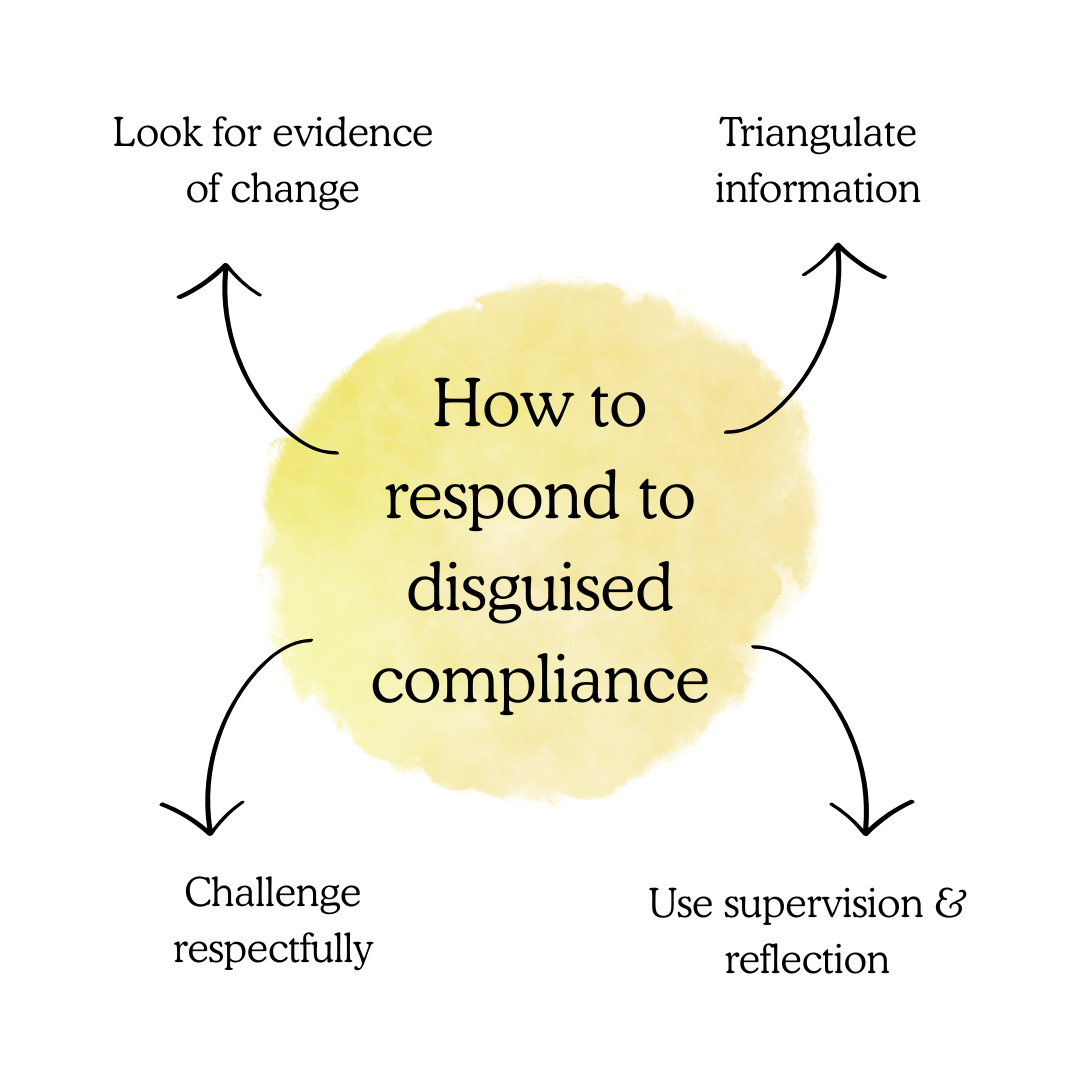
How to Respond
in cases of disguised compliance ask the following reflective questions:
- Am I basing my assessment on words or observable, sustained actions?
- What evidence do I have that the child’s situation has genuinely improved?
- Have I considered whether disguised compliance could be present?
- How can I verify progress through multiple sources?
Understanding Perpetrators
Biases and lack of confidence can obscure perpetrator patterns
Child Sexual Abuse (CSA) does not occur in isolation, it is perpetrated by individuals who actively seek opportunities to harm. To effectively safeguard children, practitioners must not only focus on victims but also understand the behaviours, tactics, and motivations of those who commit abuse.
Why is this important?
- Prevention: Recognising grooming patterns and offender strategies helps practitioners intervene earlier and reduce risk.
- Disruption: Understanding how perpetrators operate enables agencies to disrupt access to children and close opportunities for harm.
- Risk Assessment: Accurate assessments require insight into perpetrator behaviour, including manipulation (potentially of family dynamics), coercion, and control tactics.
- Challenge Bias: Without knowledge of offender profiles, practitioners may underestimate risk or misinterpret signs, leaving children vulnerable. Remember perpetrators are likely to be in a position of trust!
- Multi-Agency Response: Working with perpetrators through monitoring, rehabilitation, and risk management forms a critical part of safeguarding systems.
RECAP: Keeping the child at the centre
Every decision must prioritise the child’s safety and well-being. Remember to:
- Use reflective practice.
- Challenge personal biases.
- Seek supervision when uncertain
Use these during supervision or case discussions or ask yourself:
- What assumptions might I be making about this child or family?
- How could cultural factors influence my interpretation of the situation?
- Am I confident in the referral pathway and my responsibilities?
- Have I challenged my own biases and sought alternative perspectives?
- What additional information do I need to fully understand the child’s context?
- How can I ensure the child’s voice is central in my decision-making?
- Am I considering the possibility of grooming or perpetrator manipulation?
- What steps can I take to strengthen my professional curiosity and confidence?
Practitioner Tip: Document rationale for decisions
Quick links to guide the practitioner
below you will find a list of quick links to help you identify and respond to CSA

-
 CSA Assessment form / screening tool Exisits? or C C Of E
 -
 CSA training To develop
 -
 Procedures & policy WYConsortium
 -
 Voice of the child assessment guidance
 -
 1MG to CSA bite sized learning